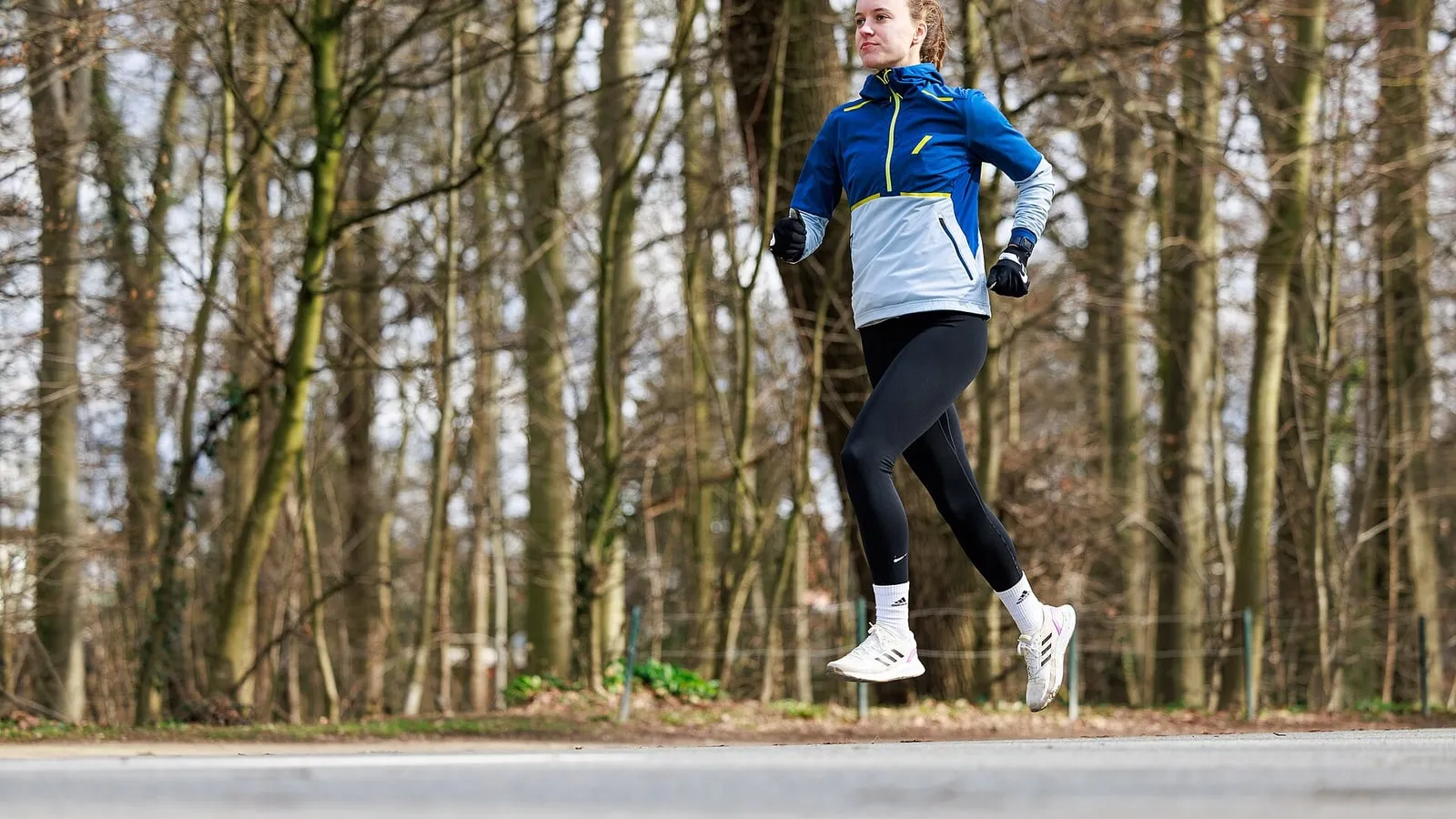
The right kit for a session is decided by what the session asks of your body, not by what looks good on a rail. A barbell workout, an indoor cycling class and a long outdoor run each load fabric, seams and fit differently, and a garment built for one is often the wrong choice for another. We start from the activity, then work back to the fabric and the cut.
Start with the movement, not the outfit#
Before you look at anything else, name the three or four movements that dominate your session. Running is thousands of repetitions in one plane, with a lot of evaporation and a lot of rub. Weightlifting is a handful of large efforts with the hips, knees and shoulders moving through a wide range. Cycling locks the hips in place and keeps the knees bending in a narrow track. Mat work puts pressure and friction on the body against the floor. Each of those patterns sets a different brief.
That brief names the properties you need: how much stretch, how much ventilation, where seams must not sit, and whether the fabric has to survive abrasion or repeated washing. Once you know the brief, choosing between two garments becomes a comparison rather than a guess.
Strength training and lifting#
Lifting rewards fabric that moves with the hip and shoulder without sliding. A knit with some elastane in it gives you that; a stiff woven short will not. We look for a gusset in the crotch of shorts and trousers, because it removes the single seam that would otherwise sit exactly where a deep squat pulls hardest.
Tops matter less than most people think, but armholes do. A high, tight armhole restricts the shoulder when you press overhead. A dropped or raglan shoulder gives more room. Anything involving a belt, a barbell or a bench will also abrade your back and thighs, so a denser knit holds up better than a thin one that pills on contact.
Indoor cycling and spin#
Cycling kit is close-fitting for a reason, and it is not vanity: loose fabric catches air, and in a room full of riders, loose fabric also catches the saddle. The key contact points are the seat bones and the inner thigh, and they need fabric with a smooth surface and enough compression to stay in place rather than bunching.
Chamois padding is a personal matter and you can ride well without it, but if you use it, the pad should sit flat against the body when you are standing rather than folding. Look for flat seams around the pad edge; a raised seam there will find you on a long ride. On the upper body, a top with a full-length zip lets you dump heat as the room warms up.
Running outdoors#
Running kit has to handle two problems at once: a lot of sweat and a lot of friction. Smooth, thin knits with a wicking finish work well, and flat seams matter more here than almost anywhere else. Overlocked seams, the ones with a visible stitched ridge, can rub along the inner arm, the bra line or the inner thigh over a long run.
Shorts come in two broad families. A loose short with a liner gives airflow, but the liner has to be sized correctly or it rides up. A fitted short stays put and reduces chafe, at the cost of warmth and coverage. Both are legitimate; the choice depends on how far you are going and how hot it is. For tops, lighter colours heat less in sun, though dark colours hide sweat patches if that matters to you. Socks are part of the running kit, not an afterthought: a synthetic or wool blend keeps its shape better than cotton, which holds moisture and softens against the skin.
Yoga, pilates and studio classes#
Studio work is about coverage, opacity and freedom of the shoulder. The single most useful test is a forward fold and a wide-legged stretch: if the fabric goes sheer or the waistband rolls, the garment is wrong for the class. Four-way stretch knits hold shape through those positions better than two-way stretch, which only gives in one direction.
Tops should stay out of the way when you invert. A fitted top with a secure hem, or a top long enough to tuck, solves that. Be wary of any waistband that is a single narrow elastic band rather than a wider knit or encased band; narrow bands dig in when you sit or fold.
High-intensity intervals and circuits#
Circuits mix patterns, so kit has to be a compromise. You will move laterally, jump and lie down, sometimes within a minute. Full-range stretch fabrics with a secure waistband and no loose hems work best. Pockets are a nuisance here, since a phone bouncing against the thigh is a distraction and a zip pull can dig in during floor work.
If the session includes rope work, burpees or dumbbell work close to the body, check the surface of the fabric for snag resistance. A tight knit or a slightly compacted knit handles contact better than an open, brushed one.
Court and field sports#
Court sports ask for lateral movement, quick stops and constant direction changes, which puts stress on the seams around the hip and on the fabric over the knee. Look for stretch woven shorts with a gusset, or a knit with a higher elastane content. Pockets need to be flat and ideally zipped, because anything loose swings when you stop.
Field sports add weather and grass stains to the list. Darker colours hide mud, and a slightly denser fabric resists abrasion from tackles and falls. Whatever you choose will be washed often, so favour garments that can take a warm wash without losing shape.
What the label tells you before you buy#
Turn the garment over and read three things. Fibre content tells you how it will handle moisture and heat. Seam type tells you how it will feel against skin. The care label tells you whether you can wash it the way you actually wash things, which for most people is a mixed load and a tumble dryer.
If a garment needs to be hand washed, laid flat to dry and kept away from heat, that is a commitment. It can be worth making for a piece you love, but it is a cost that does not appear on the tag.
Buying for the session you actually do#
Most people train in two or three ways, not eight. Build the kit around those two or three and resist the urge to buy a specialist garment for a session you attend once a season. A small number of well-chosen pieces that suit your real week will outperform a wardrobe of things bought for an imagined one.